


[Event Summary] MAFF Hosted Side Event at UNCCD COP17 in Mongolia
~MAFF Hosted Side Event on Regenerative Agriculture and Sustainable Land Management at UNCCD COP17~
|
|
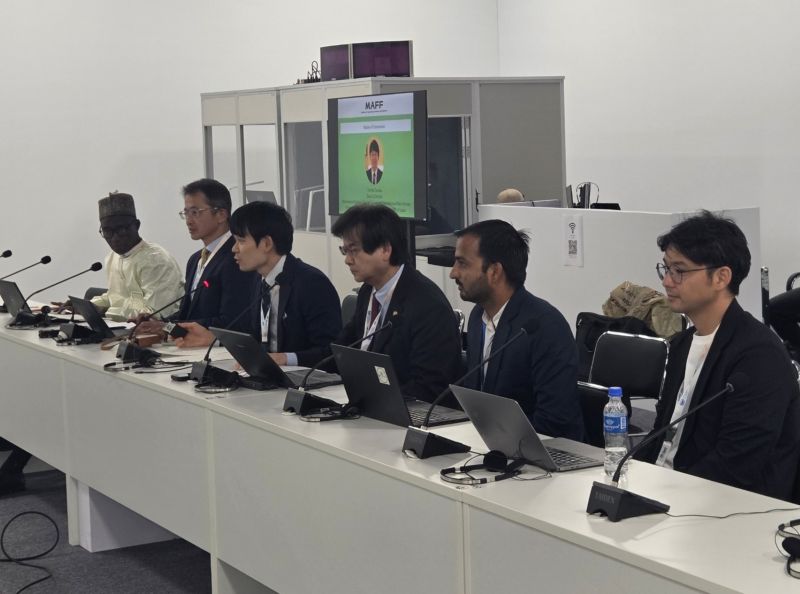
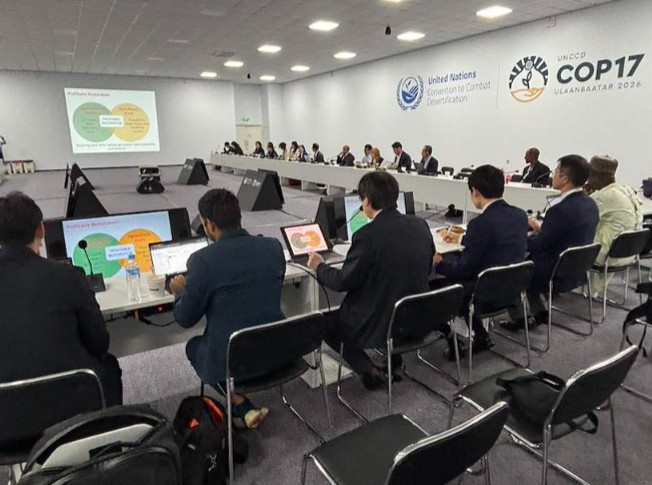
The Ministry of Agriculture, Forestry and Fisheries (MAFF) of Japan hosted a side event titled “Regenerative Agriculture and Sustainable Land Management: Japan’s Innovative Technologies and Approaches” at the 17th session of the Conference of the Parties of the United Nations Convention to Combat Desertification (UNCCD COP17) held in Ulaanbaatar, Mongolia. The event took place on Friday, August 21, 2026, and was co-hosted by the International Platform for Dryland Research and Education (IPDRE) of Tottori University, and the Japan International Cooperation Agency (JICA).
As land degradation countermeasures have become urgent global issues, Japan possesses a wide range of promising technologies and products that contribute to soil conservation and sustainable land management. This side event highlighted Japanese private-sector companies that are developing and promoting such innovations to gain a deeper understanding of effective collaboration among governments, the private sector, academic institutions and international organizations for achieving sustainable land management.
1. About Regenerative Agriculture and Sustainable Land Management
Sustainable Land Management (SLM) is gaining international attention for its potential to create synergies among land restoration, climate change mitigation, and biodiversity conservation. Particularly, land degradation has become an urgent global challenge in many regions, including Africa, Latin America, and Southeast Asia, making the conservation and restoration of agricultural soils increasingly important.
At the UNCCD COP16 held in Saudi Arabia in 2024, efforts to promote agricultural soil conservation were encouraged. Building on this, UNCCD COP17, held in Mongolia from 17 to 28 August 2026, continues discussions on the prevention, reduction, and restoration of soil degradation in agricultural land, as well as on drought-related issues. In parallel, international momentum for addressing land degradation continues to grow. At the seventh session of UN Environment Assembly (UNEA7) in 2025, the promotion of measures to combat land degradation was positioned as one of the key priorities in Medium-Term Strategy (2026-2029) of the United Nations Environment Programme (UNEP), reflecting the accelerating commitment of the international community.
2. Event Summary
Building on this momentum, on Friday, August 21, 2026, MAFF hosted the side event titled “Regenerative Agriculture and Sustainable Land Management: Japan’s Innovative Technologies and Approaches” at the UNCCD COP17.
The side event opened with a keynote address by Professor Atsushi Tsunekawa of Tottori University, under the title “Profitable Restoration: Linking Sustainable Land Management and Regenerative Agriculture.” He highlighted the importance of collaboration among stakeholders, including governments, the private sector, academic institutions, and international organizations, from the perspective of restoring and regenerating land in a financially profitable manner. In addition to introducing research projects undertaken by Tottori University in Ethiopia and other countries in collaboration with JICA, he also introduced the MAFF’s policy, outlined in the “MIDORI BOOST” released in June, to clarify the concept of regenerative agriculture in Japan under its Asian monsoon climate conditions.
This was followed by a presentation from Mr. Narayan Lal Gurjar, CEO of EF Polymer K.K.(external link), under the title “Restoring Land, Restoring Water: 100% Organic Biodegradable Polymer Made from Bio Waste for Water Saving in Agriculture.” He introduced the company’s 100% naturally derived super absorbent polymer developed through the upcycling of crop residues and discussed its potential applications in regenerative agriculture and SLM. Drawing on examples such as the Climate Resilient Agriculture and Food Transformation (CRAFT) project in Senegal, implemented in cooperation with MAFF and the World Food Programme (WFP), he showcased how the technology can contribute to addressing land degradation and enhancing agricultural resilience.
Mr. Kenshi Kobayashi, Project Manager of Sagri Co., Ltd.(external link), then presented under the title “Satellite × AI Monitoring of Farmland Soil Carbon for Combating Land Degradation.” He introduced the company’s technologies that leverage satellite data and AI to analyze agricultural land parcels, monitor soil carbon, and support water management in paddy fields. He also highlighted initiatives aimed at advancing regenerative agriculture and SLM through the application of these technologies, including projects in collaboration with MAFF.
Following these presentations, a panel discussion was held inviting Professor Tsunekawa, Mr. Gurjar and Mr. Kobayashi, joined by Dr. Salifou Mahamadou from CILSS (Comité permanent Inter-Etats de Lutte contre la Sécheresse dans le Sahel). The panel discussion explored effective approaches, challenges and expected public sector roles to promote SLM at the global level, in collaboration among diverse stakeholders. The discussion also focused on practical pathways and opportunities for scaling up and mainstreaming these technologies, with a view to facilitating their wider adoption and implementation.
The event concluded with closing remarks by Ms. Sarah Toumi of the UNCCD Secretariat, who referred to the Business4Land initiative(external link) initiative, a private-sector network promoted by the Secretariat to advance land conservation and SLM efforts.
Through partnerships with diverse stakeholders, including the private sector, MAFF will continue to contribute to the promotion of regenerative agriculture and SLM internationally.
Appendix
Presentation by Tottori University(PDF : 1,704KB)
Presentation by EF Polymer K.K.(PDF : 6,244KB)
Presentation by Sagri Co., Ltd.(PDF : 989KB)
Contact
International Strategy Division, Export and International Affairs Bureau
TEL:+81-3-3502-8397


