


Criteria for Determining Articles that Clearly Pose No Risk of Spreading Pathogens of Monitored Infectious Diseases (Exclusion Criteria)
- Act: Act on the Prevention of Infectious Diseases in Livestock
- Regulation: Regulation for Enforcement of the Act on the Prevention of Infectious Diseases in Livestock
In Japan, in order to prevent the introduction of pathogens of monitored infectious diseases through livestock and animal products, certain items are designated as “Designated Prohibited Items” under Article 36 of the Act and“Designated Quarantine Items”under Article 37. These Designated Prohibited Items and Designated Quarantine Items (hereinafter collectively referred to as the “Designated Items”) are subject to import quarantine. On the other hand, products such as canned goods and leather products, which are clearly recognized as posing no risk of spreading pathogens in light of their manufacturing processes or treatment conditions, are excluded from the scope of the Designated Items even when they are derived from materials that would otherwise fall under the Designated Items. Specific criteria for determining such products are stipulated in the Specific Matters Prescribed by the Director General, Animal Quarantine Service as Articles that are Clearly Recognized, in Consideration of Their Manufacturing Processes or Other Circumstances, as Posing No Risk of Spreading Pathogens of Monitored Infectious Diseases(MAFF AQS Notification No. 252 of 2026, dated July 1, 2026) (hereinafter referred to as the “Exclusion Criteria Notification”). |
- Background to the Establishment of the Exclusion Criteria
- Responsibilities of Importers
- About the Exclusion Criteria
- Briefing Materials and Q&A
- Links
Background to the Establishment of the Exclusion Criteria
▶Background to the Establishment of the Exclusion Criteria (CLICK)
In light of recent developments, including outbreaks of infectious diseases in livestock, the increasing volume of meat products and other animal-derived products being brought into Japan without undergoing the required import quarantine procedures, and the increasingly serious nature of such violations, the Act on the Prevention of Infectious Diseases in Livestock was partially amended (promulgated on May 19, 2026).
As part of this amendment to strengthen the import quarantine system, the sale and other distribution within Japan of meat products and similar articles that have been imported without properly undergoing import quarantine procedures were prohibited. As a result, penalties now apply not only to the illegal importation of Designated Items, but also to their sale or other distribution within Japan.
To further clarify the scope of the Designated Items, amendments to the Regulation for Enforcement that took effect on July 1, 2026 expressly clarified that animal products derived from Designated Quarantine Items, including processed products thereof, are themselves considered Designated Quarantine Items. At the same time, articles that are clearly recognized, in light of their manufacturing processes or other circumstances, as posing no risk of spreading pathogens of monitored infectious diseases (“Excluded Articles”) were expressly provided for as being excluded from the scope of Designated Quarantine Items. In addition, the specific criteria for such exclusion were established and published through the Exclusion Criteria Notification.
Responsibilities of Importers
The Exclusion Criteria Notificationestablishes the following responsibilities for importers:
1 Before importing an article, confirm whether it satisfies the applicable Exclusion Criteria by referring to the latest criteria published on the Animal Quarantine Service (AQS) website.
2 If it is unclear whether the article satisfies the Exclusion Criteria, consult the Animal Quarantine Service prior to importation and provide supporting documentation, such as an ingredient list and a description of the manufacturing process.
3 If, at the time of importation, the Animal Quarantine Service requests confirmation as to whether the imported article qualifies under the Exclusion Criteria, present documents or other evidence demonstrating that the article satisfies the applicable criteria.
4 Articles marked “Processed Animal Protein” in the remarks column of the Exclusion Criteria Table are subject to regulation under the Import Quarantine Implementation Guidelines for Suspension Measures on Processed Animal Protein Imports (Annex to MAFF Notification No. 17 Shoan 2891 of 2005, dated August 12, 2005). In addition, articles marked “Inspection Required” must undergo import inspection.
5 If an imported article is subject to inspection, the importer must promptly notify the Animal Quarantine Service, submit an application for import inspection, and present the article for inspection in its imported condition without alteration.
If, during customs clearance procedures, you are requested to declare that the article qualifies under the Exclusion Criteria, please use the prescribed declaration form available here(WORD : 19KB)
About the Exclusion Criteria
The Exclusion Criteria Notificationsets out the exclusion criteria in tabular form. Articles that satisfy the criteria, as well as products further processed from such articles, are treated as Excluded Articles.However, an article produced by adding Designated Items to an Excluded Article is treated as Designated Items. Furthermore, even where an article otherwise qualifies as an Excluded Article, it remains subject to import inspection pursuant to Article 40, paragraph (2) of the Act if it is, or is suspected of being, contaminated with pathogens of a monitored infectious disease.
In addition, products falling within a product category listed in the Exclusion Criteria Table do not qualify as Excluded Articles unless they satisfy the applicable criteria.
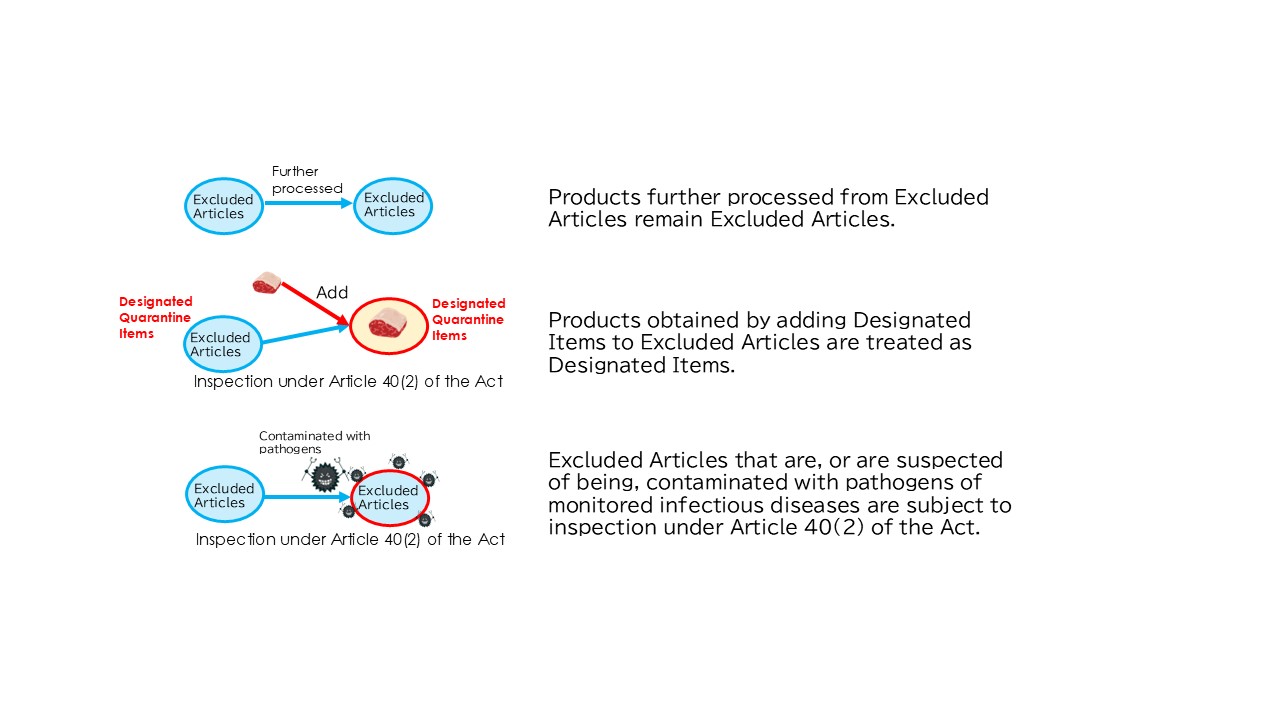
The detailed criteria are set out below.
Please refer to here(PDF : 85KB)for the meanings of the terms used in the Exclusion Criteria.
Click on each item below to view the criteria.
▶Standards 1 and 2: Pharmaceuticals, Veterinary Pharmaceuticals, Quasi-drugs, and Cosmetics
- 【Standard 1】
- At the time of importation, the product has obtained approval under the Act on Securing Quality, Efficacy and Safety of Products Including Pharmaceuticals and Medical Devices (Act No. 145 of 1960).
- The product is commercially distributed in the country of production as a product for medical, veterinary, pharmaceutical, or cosmetic use.
- 【Examples】 Pharmaceuticals, Veterinary pharmaceuticals, Quasi-drugs, Cosmetics
- 【Standard 2】 The product is presented in its final form for medical, pharmaceutical, or cosmetic use.
- 【Examples】 Gelatin capsules, Hemostatic materials (collagen sponges, etc.), Surgical sutures (collagen threads, catgut, etc.), Ophthalmic collagen shields, Bone substitutes, Kampo medicines(*) (sliced velvet antler, velvet antler powder, antelope horn powder, bovine horn powder, Calculus bovis, Calculus bovis powder, bovine gallbladder powder, porcine gallbladder powder, musk powder, bee larva powder, etc.), Immunoglobulin preparations, Therapeutic or prophylactic preparations, Vaccines, Beauty serums, Lotions, Creams
(*) Kampo medicines include crude drugs listed in the Japanese Pharmacopoeia or the Japanese standards for non-Pharmacopoeial crude drugs, provided that they cannot be diverted for other uses.
▶Standards 3 and 4: Retort Pouch Products
- 【Standard 3】 The product is packed in an airtight container(*) in such a manner that the contents are in close contact with the container, and is industrially manufactured by retort sterilization under pressure and heat after sealing so that the sterilizing effect reaches the center of the product, achieving an F₀ value of not less than 3 (equivalent to the heating effect obtained by heating at 121.1°C for 3 minutes), provided, however, that this is limited to products whose moisture content exceeds 40% or whose water activity is 0.85 or more.
(*) Airtight container means a container capable of maintaining a hermetically sealed condition that prevents the ingress of outside air and the leakage of its contents. Containers closed by means such as zipper (zip-lock) seals or metal clips, which are reopenable and do not provide a reliable airtight seal, shall not be regarded as airtight containers.
- 【Examples】 Canned foods, Bottled foods, Retort pouch foods, Retort pet food, Tray-packed retort products
- 【Standard 4】 The product contains liquid, is packed in an airtight container(*) in such a manner that the contents are in close contact with the container, and is capable of being stored unopened at room temperature for 12 months or longer, provided, however, that this is limited to products manufactured on an industrial scale.
(*) Airtight container means a container capable of maintaining a hermetically sealed condition that prevents the ingress of outside air and the leakage of its contents. Containers closed by means such as zipper (zip-lock) seals or metal clips, which are reopenable and do not provide a reliable airtight seal, shall not be regarded as airtight containers.
- 【Examples】 Canned foods, Bottled foods, Retort pouch foods, Retort pet food, Tray-packed retort products
▶Standard 5: Musical Instruments
- 【Standard 5】 The product is a musical instrument, a semi-finished product thereof, or a part thereof, provided, however, that this is limited to products that have been processed to the extent that they can be used as musical instruments (excluding assembly and similar operations).
- 【Examples】 Articles classified in HS Chapter 92
- (Shamisen and parts thereof (such as bridges, plectrums, and tuning pegs), Guitars and guitar parts (such as nuts, saddles), Shofar, Quijada, Chajchas, Drums, Drum skins, Shamisen skins, Mallet, Mute, Morin Khuur, Bows for a stringed instrument, Bow hair, String instrument strings, Snare drum wires)
▶Standard 6: Handicrafts, Household Goods, Apparel Items, and Miscellaneous Goods
- 【Standard 6】 The product is a handicraft, an article of daily use, an apparel item, a miscellaneous good, or a semi-finished product or part thereof.
- 【Examples】 Articles classified in HS Chapter 96, including buttons, button blanks, seals, seal blanks, carving, brushes, paintbrushes, writing brushes, feather dusters, and brush knots. Tableware, Decorative eggs (Easter eggs, Fabergé eggs, Pysanky, etc.)
▶Standard 7: Specimens and Taxidermy
- 【Standard 7】 The product is a specimen, a taxidermy mount, or a part thereof.
- 【Examples】 Skeletal specimens, Trophies, Taxidermy mounts (including temporary taxidermy mounts, and freeze-dried taxidermy specimens), Specimens
▶Standard 8: Industrial Products
- 【Standard 8】 The product is an industrial product, or a semi-finished product or part thereof, including products that have been processed or prepared for inspection or evaluation purposes.
- 【Examples】 Soap, Candles, Industrial lubricants, Tennis racket strings, Standardized artificial test soil cloths, Soiled test cloths, Cleaning-process indicators, Cleaning-assessment indicators
▶Standard 9: Ossein
- 【Standard 9】 The product consists of bone that has been treated with acid and decalcified (with the calcareous constituents removed).
- 【Example】 Ossein
Subject to regulations under the Import Quarantine Implementation Guidelines for Suspension Measures on Processed Animal Protein.
▶Standard 10: Calcium Phosphate
- 【Standard 10】 The product is obtained by neutralizing the decalcification solution derived from acid treatment of bone.
- 【Examples】 Monocalcium phosphate, Dicalcium phosphate, Tricalcium phosphate, Superphosphate fertilizers, single superphosphate
Subject to regulations under the Import Quarantine Implementation Guidelines for Suspension Measures on Processed Animal Protein.
▶Standard 11: Bone Char and Derivatives
- 【Standard 11】 The product is carbonized bone or a tar-like oil obtained during the carbonization process (Dippel's oil).
- 【Examples】 Bone char, Dippel’s oil
Subject to regulations under the Import Quarantine Implementation Guidelines for Suspension Measures on Processed Animal Protein.
▶Standard 12: Bone Ash
- 【Standard 12】 The product consists of calcined bone.
- 【Example】 Bone ash
Subject to regulations under the Import Quarantine Implementation Guidelines for Suspension Measures on Processed Animal Protein.
▶Standard 13: Foods or Pet Food Containing Bone-derived Material
- 【Standard 13】 The product is a food or pet food containing bone-derived material as one of its ingredients, provided that the bone structure is no longer discernible and the product is presented in its final form for end use.
- 【Example】 Health foods or pet food containing bone-derived calcium as an added ingredient
Subject to regulations under the Import Quarantine Implementation Guidelines for Suspension Measures on Processed Animal Protein.
▶Standards 14 and 15: Extracts
- 【Standard 14】 The product is a liquid extract obtained by boiling bones, meat, hides, or similar materials for at least one hour, or by a moist-heat treatment providing an equivalent or greater effect, provided, however, that this is limited to products from which visible solid matter(*) has been removed by filtration, centrifugation, or similar methods.
(*) Visible solid matter means matter that can be readily identified as bone fragments, meat fragments, organ fragments, or fat fragments. Products that have undergone spray-drying during the manufacturing process or have been filtered through a filter of approximately 30 mesh or finer shall be deemed not to contain residual visible solid matter.
Examples of temperature and time combinations for heat treatment recognized as equivalent to boiling for at least one hour: 115°C for 2 minutes, 110°C for 6 minutes, 105°C for 19 minutes, 95°C for 190 minutes, 90°C for 600 minutes, 85°C for 1,898 minutes
Note: For products imported as cargo for the first time, importers shall obtain prior confirmation from the Animal Quarantine Service.- 【Examples】 Beef extract, Pork extract, Chicken extract, Chicken broth, Soup stock, Extract powder
- 【Standard 15】 The product is obtained by removing visible solid matter(*), by filtration, centrifugation, or similar methods, from a liquid extract derived from bones, meat, hides, or similar materials that has been subjected to moist-heat treatment and subsequently subjected to heat treatment at 100°C or higher for at least 10 minutes, or to a heat treatment providing an equivalent or greater effect.
(*) Visible solid matter means matter that can be readily identified as bone fragments, meat fragments, organ fragments, or fat fragments. Products that have undergone spray-drying during the manufacturing process or have been filtered through a filter of approximately 30 mesh or finer shall be deemed not to contain residual visible solid matter.
Examples of temperature and time combinations for heat treatment recognized as equivalent to heating at 100°C or above for at least 10 minutes:110°C for 1 minute, 105°C for 4 minutes, 95°C for 32 minutes, 90°C for 100 minutes, 85°C for 317 minutes
Note: For products imported as cargo for the first time, importers shall obtain prior confirmation from the Animal Quarantine Service.- 【Examples】 Beef extract, Pork extract, Chicken extract, Chicken broth, Soup stock, Extract powder
▶Standards 16 and 17: Animal Fats and Oils
- 【Standard 16】 The product consists of oils or fats extracted by rendering or other extraction methods from bones, fat, hides, or similar materials that have been subjected to heat treatment at 100°C or higher for at least one hour, or to heat treatment providing an equivalent or greater effect, and oils or fats separated therefrom by pressing or similar methods.
Examples of temperature and time combinations for heat treatment recognized as equivalent to boiling for at least one hour: 115°C for 2 minutes, 110°C for 6 minutes, 105°C for 19 minutes, 95°C for 190 minutes, 90°C for 600 minutes, 85°C for 1,898 minutes
- 【Examples】 Yellow grease, Bone oil, Bone fat, Tallow, Animal fat powder, Lard oil, Lard stearin
Subject to regulations under the Import Quarantine Implementation Guidelines for Suspension Measures on Processed Animal Protein.
- 【Standard 17】 The product consists of oils or fats obtained from bones, fat, hides, or similar materials that have been heat-treated and then extracted, rendered, pressed, or otherwise separated, from which visible solid matter (*) has been removed, and which have subsequently been heat-treated at 100°C or higher for at least 10 minutes, or subjected to a heat treatment providing an equivalent or greater effect.
(*) Visible solid matter means matter that can be readily identified as bone fragments, meat fragments, organ fragments, or fat fragments. Products that have undergone spray-drying during the manufacturing process or have been filtered through a filter of approximately 30 mesh or finer shall be deemed not to contain residual visible solid matter.
Examples of temperature and time combinations for heat treatment recognized as equivalent to heating at 100°C or above for at least 10 minutes:110°C for 1 minute, 105°C for 4 minutes, 95°C for 32 minutes, 90°C for 100 minutes, 85°C for 317 minutes
- 【Examples】 Bone oil, Tallow, Animal fat powder, Lard oil, Chicken oil, Lard stearin
Subject to regulations under the Import Quarantine Implementation Guidelines for Suspension Measures on Processed Animal Protein.
▶Standard 18: Refined Animal Fats and Oils
- 【Standard 18】 The product consists of oils or fats extracted by rendering or other extraction methods from heated tissues such as bones, fat, hides, or similar materials, or oils or fats fractionated therefrom by pressing or similar methods, which have been refined by degumming, deacidification, bleaching, deodorization, or similar processes.
- 【Examples】 Fatty Acids (Linoleic Acid, Stearic Acid, etc.), Lard, Refined tallow, Glycerin, Margarine, Shortening, Release agents, Blown oils, Oxidized oils, Sulfurized oils, Hydrogenated oils, Lubricants
Subject to regulations under the Import Quarantine Implementation Guidelines for Suspension Measures on Processed Animal Protein.
▶Standard 19: Gelatin, Collagen, and Glue
- 【Standard 19】
- The product is collagen, gelatin, or glue manufactured from bones or similar materials by acid or alkali treatment.
- The product is crude glue liquor separated from bones or similar materials by steaming, glue or glue residue derived therefrom, or gelatin manufactured by refining such materials.
- 【Examples】 Gelatin, Collagen peptides, Glue, Collagen (water-soluble collagen, atelocollagen, succinylated atelocollagen, etc.)
Subject to regulations under the Import Quarantine Implementation Guidelines for Suspension Measures on Processed Animal Protein.
▶Standard 20: Hydrolyzed Protein
- 【Standard 20】 The product consists of proteins or protein hydrolysates obtained by hydrolyzing tissues such as meat, hides, or similar materials using acids, alkalis, oxidizing agents, reducing agents, enzymes, or similar substances, provided, however, that this is limited to products in which no undigested solid matter(*) remains.
(*) Undigested solid matter means matter that can be readily identified as meat fragments, organ fragments, or fat fragments. Products that have undergone spray-drying during the manufacturing process or have been filtered through a filter of approximately 30 mesh or finer shall be deemed not to contain any residual undigested solid matter.
- 【Examples】 Keratin, Cystine, Placenta extract, Hydrolyzed protein, Blood peptides
Subject to regulations under the Import Quarantine Implementation Guidelines for Suspension Measures on Processed Animal Protein.
▶Standard 21: Seasonings and Flavoring Liquids
- 【Standard 21】 The product is a food or pet food containing, as part of its ingredients, meat, organs, fat, or similar materials that have been subjected to heat treatment, hydrolysis, or similar processing, and is presented in its final form for end use, provided, however, that this is limited to products in which no solid matter(*) derived from meat, organs, fat, or similar materials is present.
(*) Solid matter means matter that can be readily identified as meat fragments, organ fragments, or fat fragments. Products that have undergone spray-drying during the manufacturing process or have been filtered through a filter of approximately 30 mesh or finer shall be deemed not to contain any solid matter.
- 【Examples】 Seasonings (soup stock, consommé, etc.), Flavoring liquids, Flavorings, Pet food coating agents
Subject to regulations under the Import Quarantine Implementation Guidelines for Suspension Measures on Processed Animal Protein.
▶Standard 22: Dog Chews
- 【Standard 22】 The product is a dog chew manufactured from hides that have been sufficiently treated with alkali(*), including material prior to cutting or shaping.
(*) Sufficient alkali treatment means alkali treatment to a degree that eliminates the risk of spreading pathogens of monitored infectious diseases. Although no specific numerical criteria are prescribed, hides derived from cattle should, as a guideline, be immersed in an alkaline solution of approximately pH 11, and hides derived from swine in an alkaline solution of approximately pH 11.5, for a period sufficient to allow swelling to reach the center of the hide.
- 【Examples】 Dog chews
Materials prior to cutting or shaping are subject to inspection.
▶Standard 23: Leather and Leather Products
- 【Standard 23】 The product consists of hides, skins, or furs that have been tanned, including those undergoing the tanning process.
- 【Examples】 Tanned leather (crust leather, wet white, wet blue, chamois leather, etc.), Tanned fur, Leather products (bags, wallets, etc.), Fur products (hats, stoles, scarves, rugs, etc.), Patent leather, Composition leather, Apparel
Subject to regulations under the Import Quarantine Implementation Guidelines for Suspension Measures on Processed Animal Protein.
▶Standard 24: Scoured Wool
- 【Standard 24】 The product consists of wool that has been washed with detergent, rinsed, and dried with hot air.
- 【Examples】 Articles classified under HS subheadings 5101.21 or 5101.29 (scoured wool)
▶Standard 25: Carbonized Wool
- 【Standard 25】 The product consists of wool that has been immersed in an inorganic acid or acidic salt solution and chemically freed of vegetable impurities.
- 【Examples】 Articles classified under HS subheading 5101.30 (carbonized wool)
▶Standard 26: Wool Grease
- 【Standard 26】 The product consists of wool grease recovered during the industrial scouring of wool, and derivatives thereof.
- 【Examples】 Wool grease, Refined wool-grease products (lanolin, wool alcohols, vitamin D3, wool grease olein, wool grease stearin, etc.)
Subject to regulations under the Import Quarantine Implementation Guidelines for Suspension Measures on Processed Animal Protein.
▶Standard 27: Wool Products
- 【Standard 27】 The product consists of hair or wool that has been dyed, bleached, carded, or combed.
- 【Examples】 Dyed wool, Wool yarn, Yarn, Felt, Apparel, Carded wool, Slubbing, Sliver, Combed wool, Wool top, Carded animal hair (carded cashmere and carded mohair etc.), Cashmere top, Mohair top, Alpaca top
▶Standard 28: Feather Products
- 【Standard 28】
- The product consists of feathers or down that have been dyed or bleached.
- The product is a processed feather or down product presented in its final form for end use.
- 【Examples】 Dyed feathers, Feathers for clothing or decorative articles, Fly-tying feathers, Feather bedding and duvets, Apparel (down jackets, etc.), Ornaments and similar decorative articles, Feather decorations, Arrows, Badminton shuttlecocks, Artificial fishing flies
▶Standard 29: Dry Pet Food
- 【Standard 29】 The product is manufactured by heating and mixing raw materials, forming them into an expanded product using an extruder, and subsequently subjecting them to a hot-air drying process, provided, however, that this is limited to hard granular products in which the original raw materials are no longer visually discernible.
- 【Examples】 Dry pet food
Subject to regulations under the Import Quarantine Implementation Guidelines for Suspension Measures on Processed Animal Protein.
▶Standard 30: Feed for Companion, Laboratory, or Exhibition Animals
- 【Standard 30】 The product is manufactured by heating and mixing raw materials and subsequently forming them under heat and pressure using a molding device, or consists of material obtained by grinding such a product, provided, however, that, during processing, the product has been subjected to moist-heat treatment at not less than 100°C for at least one hour, or to a heat treatment providing an equivalent or greater effect, that the original raw materials are no longer visually discernible, and that the product is presented in its final form for end use for companion, laboratory, or exhibition animals other than cloven-hoofed animals, horses, and poultry.
- 【Examples】 Pellet feed for pet birds, Pellet feed for exotic animals, Pellet feed for rodents, Pellet feed for zoo animals
Subject to regulations under the Import Quarantine Implementation Guidelines for Suspension Measures on Processed Animal Protein.
▶Standard 31: Dried Toppings for Instant Foods
- 【Standard 31】
- The product is a dried ingredient contained in a cup-type instant food presented in its final form for end use, limited to products that are completed by adding hot water directly to the cup without any cooking process using a pot or similar equipment, provided, however, that this is limited to products manufactured on an industrial scale.
- The product is a dried ingredient contained in a pouch-type instant food presented in its final form for end use, limited to products that are completed by transferring the contents to a bowl or other container and adding hot water, without any cooking process using a pot or similar equipment, provided, however, that this is limited to products manufactured on an industrial scale.
- 【Examples】 Instant cup noodles, Instant yakisoba, Instant pasta
▶Standard 32: Fractionated or Purified Products
- 【Standard 32】 The product has been fractionated or purified by any of the following methods, provided, however, that this is limited to products intended for use in testing, research, or other similar purposes.
- • Heat fractionation
- • Ammonium sulfate precipitation (fractionation)
- • Cold organic solvent treatment (Cohn fractionation)
- • Affinity chromatography
- • Ion-exchange chromatography
- • Chromatofocusing
- • Hydrophobic interaction chromatography
- • Gel-filtration chromatography
- • Electrophoresis
- • Negative selection
- 【Examples】 Purified antibodies (immunoglobulins), Purified heparin, Purified fetuin, Purified cephalin, Purified tropomyosin, Serum albumin (BSA), Purified lysozyme, Purified avidin, Purified egg-yolk antibodies, Purified nucleic acids, Purified urinary proteins
▶Standard 33: Enzymes, Hormones, and Bile Acids
- 【Standard 33】 The product is an enzyme, hormone, or bile acid extracted and purified from organs or similar materials.
- 【Examples】 Rennet, Trypsin, Pepsin, Pancreatin, Catalase, Lipase, Purified hormones, Purified enzymes, Bile acids
▶Standard 34: Culture Media and Diagnostic Reagents
- 【Standard 34】 The product is a testing material or reagent product that contains no solid matter derived from meat or similar materials and is presented in its final form for end use.
- 【Examples】 Culture medium bases, Culture medium supplements, Diagnostic reagents, Cell culture kits
▶Standard 35: Research and Testing Products
- 【Standard 35】 The product is a testing material or reagent product intended for use in testing, research, or other similar purposes, containing blood, blood fractions, or components derived from meat, organs, or similar materials as part of its constituents, and is presented in its final form for end use.
- 【Examples】 Blood-supplemented media, Blood agar media, Cell culture kits, Biological sample collection cards containing meat or organ extracts, Biological sample collection cards containing blood or blood fractions
▶Standard 36: Diagnostic Test Kits
- 【Standard 36】 The product is presented in its final form for end use as a diagnostic test kit.
- 【Examples】 Diagnostic test kits (including complete diagnostic test kits containing standard sera or antisera)
Products intended for the testing or diagnosis of notifiable infectious diseases are subject to inspection.
▶Standard 37: Diagnostic Products
- 【Standard 37】 The product has been processed or prepared to the extent that its use for a specific test or diagnosis within a particular closed facility, such as a research institution or medical institution, is evident, and is one of the products listed in the right-hand column. The product is presented in its final form for end use.
- 【Products listed in the right-hand column】 Brain-derived extracts added to cells for research purposes, Serum added to cells for research purposes, Antibody-containing serum, Immune serum (antiserum), Serum supplemented with antibodies, Complement-containing serum, Complement serum, Serum supplemented with complement, Positive control serum, Calibration standard serum used for biochemical testing and similar purposes
Products intended for the testing or diagnosis of notifiable infectious diseases are subject to inspection.
▶Standard 38: Fixed Tissues and Microscope Slides
- 【Standard 38】 The product consists of tissue or a microscope slide preparation that has been fixed in a fixative composed of aldehydes, alcohols, or similar substances.
- 【Examples】 Fixed tissues (including whole specimens fixed in their entirety, such as fetuses), Paraffin blocks, Microscope slide preparations, Plastinated specimens, Imprint specimens
▶Standard 39: Inactivated Blood and Serum
- 【Standard 39】 The product consists of blood or a blood fraction that has been treated by one of the following methods, provided, however, that this is limited to products intended for use in testing, research, or other similar purposes.
- • Boiling for at least one hour
- • Addition of a chemical agent (limited to formalin, β-propiolactone, or glutaraldehyde).
- 【Examples】 Formalin-treated blood/serum, β-propiolactone-treated blood/serum, Glutaraldehyde-treated blood/serum, Fixed whole blood, Fixed blood cells, Positive specimen panels
▶Standard 40: Established Cell Lines
- 【Standard 40】 The product consists of an established cell line for use in testing, research, or other similar purposes (cells that have become immortalized during the serial passage of cultured cells).
- 【Examples】 Established cell lines (immortalized cells)
▶Standard 41: Eggs Denatured by Heat or Alkali Treatment
- 【Standard 41】 The product consists of eggs in which the egg proteins have been completely coagulated and denatured by heat treatment or alkali treatment, provided, however, that this excludes products containing tissues other than egg white or egg yolk (such as balut).
- 【Examples】 Hard-boiled eggs, Smoked eggs, Preserved eggs (pidan), Songhua eggs, Decorative processed eggs, Tamagoyaki (Japanese omelet), Omelets, Long eggs, Egg sandwiches, Cakes, Confectionery products
▶Standard 42: Foods and Pet Food Containing Eggs
- 【Standard 42】 The product is a food or pet food in which eggs are not the principal ingredient (i.e., the ingredient accounting for the greatest proportion by weight of the raw materials).
- 【Examples】 Dough products, Egg noodles, Ice cream, Custard cream, Seasonings (mayonnaise, dressings, sauces, etc.), Pet food containing egg protein
▶Standard 43: Egg Yolk Extracts
- 【Standard 43】 The product consists of oil extracted from egg yolk by one of the following methods:
- • heat concentration and pressing
- • addition of an organic solvent.
- 【Examples】 Egg yolk oil, Lecithin
▶Standard 44: Heat-Treated Egg Powder
- 【Standard 44】 The product consists of powdered egg manufactured by the spray-drying process.
- 【Examples】 Spray-dried egg products (whole egg powder, egg yolk powder, and egg white powder)
Subject to regulations under the Import Quarantine Implementation Guidelines for Suspension Measures on Processed Animal Protein.
▶Standard 45: Heat-Treated Eggshells and Eggshell Membranes
- 【Standard 45】 The product consists of eggshells or eggshell membranes that have been washed, dried, and ground, and subsequently heat-treated by one of the following methods:
- • heat treatment at 51.7°C for 73.2 hours, 54.4°C for 50.4 hours, or 67°C for 20 hours;
- OR
- • heat treatment at 100°C or higher.
- 【Examples】 Eggshell powder, Eggshell membrane powder, Calcium carbonate, Eggshell calcium
Subject to regulations under the Import Quarantine Implementation Guidelines for Suspension Measures on Processed Animal Protein.
▶Standard 46: Products Containing Eggshells
- 【Standard 46】 The product contains eggshells as one of its ingredients and is presented in its final form for end use.
- 【Examples】 Health foods or pet food supplemented with eggshell calcium
▶Standard 47: Shelf-Stable Milk Products
- 【Standard 47】 The product falls within the category of shelf-stable products specified by the Milk and Milk Products Ordinance.
- 【Examples】 Shelf-stable milk products (long-life milk (LL milk) etc.)
▶Standard 48: Unsweetened Condensed Milk
- 【Standard 48】 The product falls within the category of unsweetened condensed milk or unsweetened skimmed condensed milk as specified by the Milk and Milk Products Ordinance.
- 【Examples】 Unsweetened condensed milk, Unsweetened skim condensed milk, Evaporated milk
▶Standard 49: Fermented Milk and Lactic Acid Bacteria Beverages
- 【Standard 49】 The product falls within the category of fermented milk or lactic acid bacteria beverages as specified by the Milk and Milk Products Ordinance.
- 【Examples】 Fermented milk (e.g., yogurt), Lactic acid bacteria beverages
▶Standard 50: Butter Oil
- 【Standard 50】 The product falls within the category of butter oil as specified by the Milk and Milk Products Ordinance.
- 【Examples】 Butter oil, Ghee
▶Standard 51: Processed Cheese
- 【Standard 51】 The product is processed cheese classified under HS heading 04.06.
- 【Examples】 Processed cheese
▶Standard 52: Fractionated and Purified Milk Products
- 【Standard 52】 The product has been fractionated and purified from raw milk or milk products.
- 【Examples】 α-Lactalbumin
▶Standard 53: Pet Food or Feed Containing Milk
- 【Standard 53】 The product is shelf-stable pet food or feed in which raw milk and dairy products account for less than 50% by weight of the ingredients (excluding added water from the ingredient weight calculation), provided, however, that this excludes products intended for feeding cloven-hoofed animals.
- 【Examples】 Dry pet food, Shelf-stable pet food containing small amounts of dairy products
▶Standard 54: Products Containing Milk Outside Regulated HS Classifications
- 【Standard 54】 The product contains milk as an ingredient but is not classified under any HS classification subject to regulation as milk or milk products.
▶Standard 55: Dairy Products Not Exceeding 10 kg
- 【Standard 55】 Among products classified under HS classification subject to regulation as milk or milk products, the product is not intended for sale or commercial use and weighs 10 kg or less, provided, however, that this excludes products intended for use as feed.
▶Standard 56: Mushroom Growing Substrates
- 【Standard 56】 The product is a mushroom cultivation substrate inoculated with mushroom mycelia, in which manure or similar materials have been fermented into compost, and is presented in its final form for end use.
- 【Examples】 Mushroom cultivation substrate (growing medium) for button mushrooms
The product is subject to import inspection.
▶Standard 57: Charcoal, Ash, or Fused Products
- 【Standard 57】 The product consists of Designated Items that have been carbonized, calcined, or fused, provided, however, that this excludes bone charcoal and bone ash.
- 【Examples】 Poultry manure ash, Carbonized poultry manure, Carbonized swine manure, Fused phosphate fertilizer
▶Standard 58: Secretions Derived from Honeybees
- 【Standard 58】 The product consists of a secretion produced within the body of honeybees, or a substance formed principally from such a secretion.
- 【Examples】 Honey, Comb honey, Beeswax, Royal jelly, Propolis
Products containing honeybees or any part thereof are regarded as Designated Quarantine Items and are therefore subject to import animal quarantine. Accordingly, please confirm that the product intended for import has been manufactured by a process that ensures that no honeybees or bee body parts are incorporated into the product.
▶Standard 59: Bagasse
- 【Standard 59】 The product is a fibrous by-product obtained after extracting sugar juice from the stalks and leaves of sugar-producing plants.
- 【Examples】 Fermented bagasse, Bagasse
▶Standard 60: Pellets Manufactured from Plant Stalks and Leaves
- 【Standard 60】 The product consists of hard pellets produced by cutting or grinding the stalks and leaves of plants and molding them under heat and pressure using a molding device, provided, however, that this is limited to products that, during processing, have been subjected to moist-heat treatment at 80°C for 10 minutes or to a heat treatment providing an equivalent or greater effect.
Examples of temperature and time combinations for heat treatment recognized as equivalent to heating at 80°C for 10 minutes:85°C for 4 minutes, 90°C for 1 minute
- 【Examples】 Alfalfa pellets, Sorghum pellets, Timothy pellets
- 輸入畜産物の検査手続(Japanese Version)(Not meeting the Exclusion Criteria? Click here.)
- わら、飼料用の乾草の輸入検査手続(Japanese Version)(Not meeting the Exclusion Criteria? Click here.(Straw and Hay for feed))
- Contact Us
お問合せ先
-
ダイヤルイン:-


